Showing posts with label plantagenet. Show all posts

Sunday, August 31, 2014

The Peasants' Revolt

Our tale begins in old, merry England, shortly after about one third of the European population was swept away with that dastardly Black Death. It was really quite a dark period for all of Europe. But time went on since then. Seasons passed, children grew up, peasants worked, more meaningless wars were to be had, and so on.

c. 1310 rural scene of reeve directing serfs, from the Queen Mary Psalter

Serfdom was devastated; there were very little serfs left, and the ones who survived expected to be paid and treated by their lords like actual humans. Laws were passed to stop them from being paid, but some lords kindly and generously gave in—not all, of course, and evidently many serfs were angry about that.

Richard II
Peasants were forced to maintain the yards of churches. (I wonder why the laymen couldn't have done it. Laziness...) It was a huge annoyance to the peasants, who already had a lot of chores of their own that they needed to take care of. And to make it worse, they weren't paid—not even in the slightest form. A priest named John Ball supported these poor folk.

There was also that Hundred Years War that was going on in 1381, and they needed cash, so our good King Richard II issued a poll tax (where every living person in England over the age of fifteen has to pay one groat to the King.) It didn't help that this was the third time this happened over a period of four years. You may be thinking,“it's only a groat,” but for the poorer folk, a groat can go a long way. The peasants were annoyed, and many refused to pay. And so when the taxman came to a little village called Fobbing in Essex on the 10th of May, the villagers promptly and angrily chased him out.

The taxman was outraged. He brought this to the Court of Common Pleas. The chief justice soon arrived to reprimand the rebelling villagers, but it would take more than just that to stop them. They threw him out too! He should have known never to under-estimate the strength of a group of angry peasants. The peasants of Kent united with the peasants of Essex—about sixty-thousand men in all. The three leaders were Wat Tyler, John Ball, and Jack Straw. Soon they resolved to march all the way to London to make the youthful, fourteen-year-old King finally listen to them. John Ball riled up fellow marchers with this sermon:
“From the beginning all men by nature were created alike, and our bondage or servitude came in by the unjust oppression of naughty men. For if God would have had any bondmen from the beginning, he would have appointed who should be bond and who free. And therefore I exhort you to consider that now the time is come, appointed to us by God, in which ye may (if ye will) cast off the yoke of bondage, and recover liberty.”
(Source)


John Ball cheers the rebels on, from Froissart's Chronicles, c. 1470.

The journey to London was fun for the rebels. Along the way they merrily ripped tax records and registers to shreds. They let prisoners flee and hop with glee. Some other poor folk happily joined the rebellion, too. The King's uncle's, John of Gaunt, castle was also burned down by some sneaky peasants.

The young King, frightened at this uprising as I'm sure any King would be, finally met with the rebels at Mile End on June 14th. To him the peasants petitioned for the poll tax to be gone, serfdom to be abolished, and for certain people such as John of Gaunt to be killed. The King gladly agreed, as long as they'd all just leave London. Many left, but many also stayed just to murder the Archbishop and Lord Treasurer. They put the heads on pikes and they held them in the air while they pranced around the city. Because they got what they wanted from the King, they wanted to continue this chaotic celebration.

Wat Tyler, along with his rebels from Kent, and the King met again the next day at Smithfield. The Lord Mayor of London, William Walworth, saw this as a perfect opportunity to murder Wat. He pushed Wat off his horse and a squire of the King finished him off with a stab in the stomach. The only problem was that the murderers were surrounded by his followers. The King said to them, “I am your captain, follow me!” and he led them away from the corpse. Shortly after that, the rebels went their separate ways to home. As for the other leaders, John Ball was hanged, drawn, and quartered while Jack Straw was also executed.

Wat Tyler is killed. Froissart's Chronicles, c. 1470. (King is shown twice)

The revolt was practically over now. Turns out the King never really kept his promise. He did eliminate the poll tax, but everything else he claimed was made under threat and not valid. Serfdom slowly died out all on its own, and good lords made their remaining serfs free men. Any peasants who still rebelled were likely executed. All's well that ends well.

Wednesday, July 30, 2014

Hugh Despenser the Younger, Favorite and Chamberlain of the King

During the good ol' days of King Edward II of England, there lived a man named Hugh Despenser the Younger. He was the King's favorite, his chamberlain and possibly even lover. So why exactly was happy, hearty Hugh's ultimate fate to be so brutally hanged, drawn and quartered?

When King Edward I (nicknamed “Longshanks,” haha!), Edward II's father, was still ruling England, he was buddies with Hugh's dad. So much so that he arranged a marriage for his granddaughter, Eleanor de Clare, and lil' Hugh. This gave Hugh a good name around nobility.

Fast forward a few years later, while Longshanks's son is on the throne. Eleanor's brother passed away in 1314, so Hugh went to inherit his brother-in-law's lands. Now he was rich. He had a great reputation and beautiful lands.

In 1317 Hugh became King Edward II's chamberlain. He replaced Roger d'Amory's exclusive spot as the King's favorite. What a great life, right? Being the King's best friend, being rich, being well-known... I'd be pretty satisfied. But this wasn't enough for Hugh. He wanted more.

A beautiful contemporary representation of King Edward II

The sly and manipulative chamberlain cheated people out of their land. He was cruel and terrible towards anyone that could give him something. And worst of all it was easy for him to get away with it. He was the King's best friend. But maybe Hugh forgot that he wasn't everyone's best friend. Nobody else liked Hugh. Queen Isabella certainly hated him. John of Nottingham, a renowned magician during the time, had a plot to kill him and the King by sticking pins into dolls that looked like them. And if a famous medieval magician hates you, my friend, everybody hates you.

In 1321 the people revolted against Hugh and had him and his father exiled from England for a while. During this brief period in his life he became a pirate. But only about a year later he was let back into England, and became the King's favorite once more. Most of Hugh's enemies were gone someway or another. Hugh was back to the usual stuff: taking land, robbing people, torturing people if they didn't listen to him. He was incredibly powerful once again and practically acted as King. Happily ever after, right? Not for long.

In 1325, Queen Isabella was basically separated from the King. She packed up her bags and went back to France. This separation made the King even more unpopular than he already was. Roger Mortimer, a member of a rivaling family with the Despensers, was exiled and living in France during this time. And so Roger and Isabella both began the very famous affair.

It was 1326. Everyone hated the Despensers and King Edward II. It was time for someone to do something about it, and the chosen ones were Isabella and Roger. After much strategic planning, and with about 1,500 soldiers, the invasion was to commence.

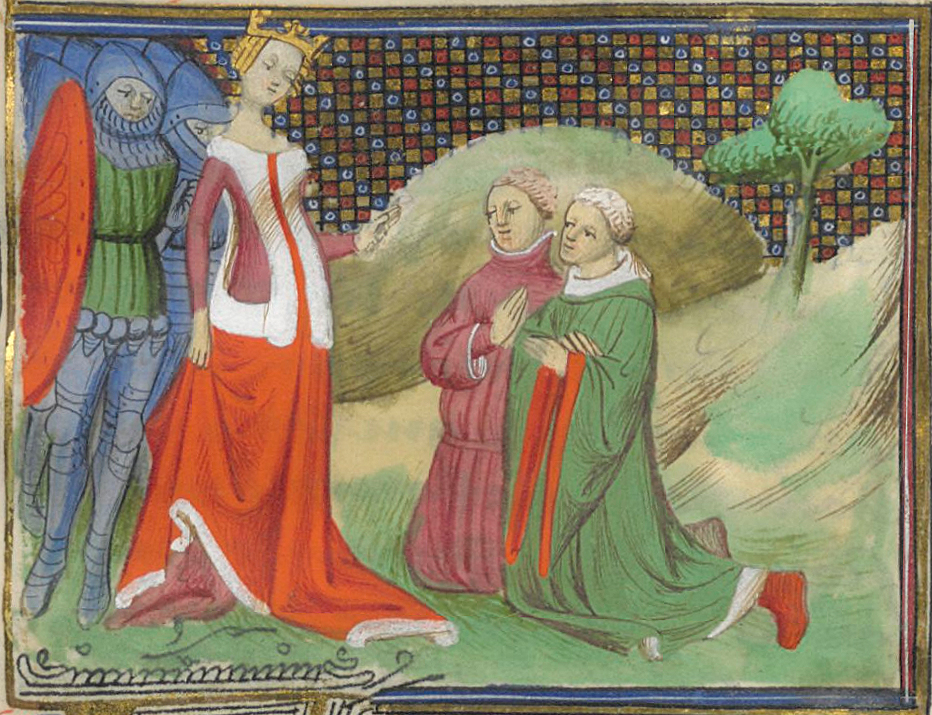
Hugh and an earl before Isabella
The invasion was a complete success. The Despensers and the King tried to run, but they were captured. Hugh's father was hanged. Hugh tried to starve himself before he was brought to trial. When his trial came he was judged as a traitor and a thief.

Accounts of his execution greatly differ, and we will never know how the execution really went. Jean Froissart gave an incredibly colorful description of a horrid execution (which, honestly, is so disturbing that I'm not going to include, for the sake of humanity). In a less sickening—yet still nasty—account, he was hanged on 50 ft. high gallows, but was cut down before he choked to death. He was probably just quartered, hanged, and beheaded, as most contemporaries described. Whichever telling you choose to believe, this is clear: he was grossly executed.

King Edward was forced to abdicate in favor of his son, Edward III. The King, who was crying, said, “I greatly lament that I have so utterly failed my people, but I could not be other than I am.” (Source) It's not really known how he died, but he was most likely murdered.

Poor Edward. I don't think he himself was a really bad guy. Those around him probably just took advantage of his friendliness and power. Hugh certainly did.

Well, Hugh, now you have what you deserve. You tortured and ruined the lives of tons of people—rich and poor—because you wanted lands and power. That all led to you and your friend's death. I hope you're satisfied with your reward, Hugh.